Short answer
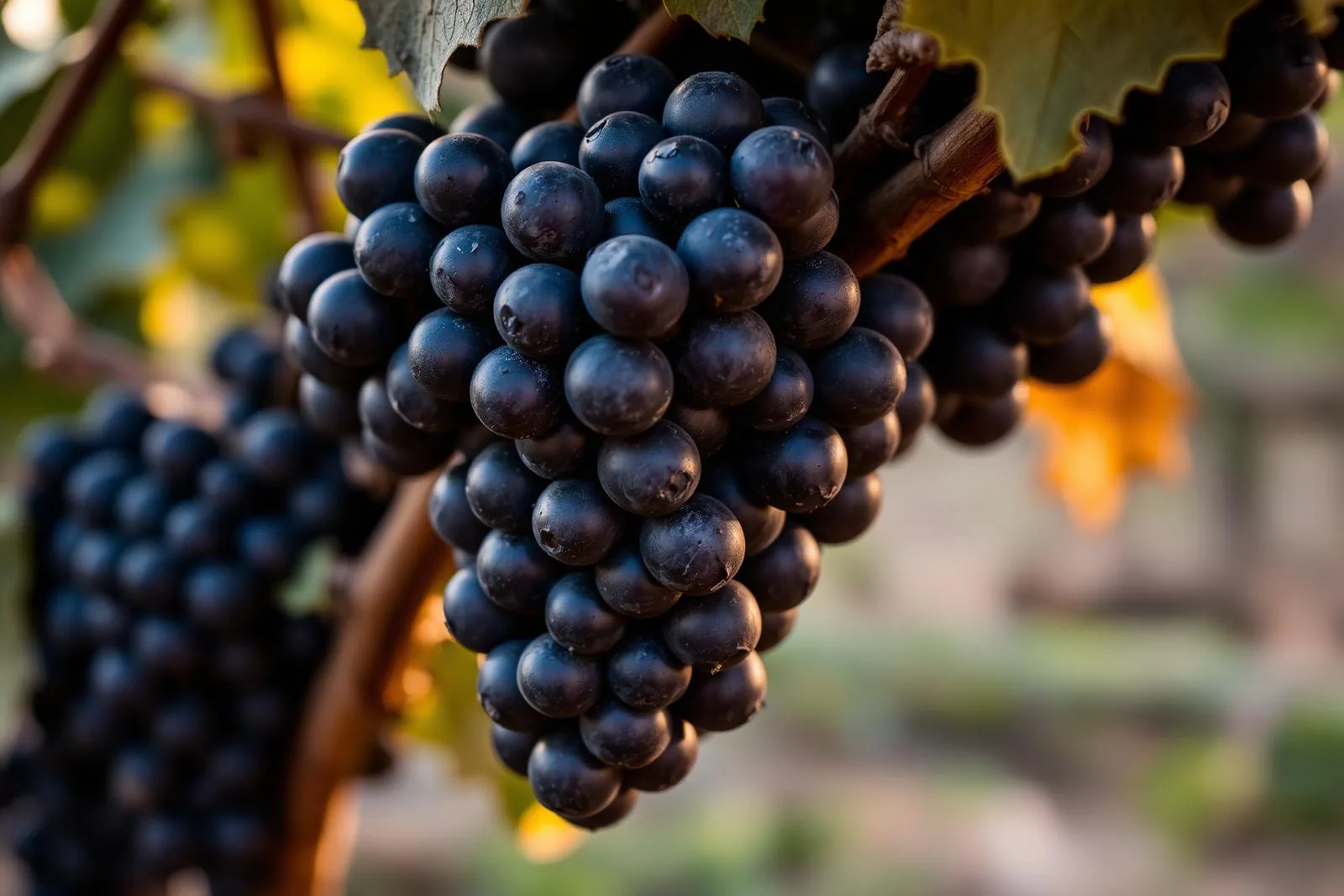
Montepulciano is a dark red grape from Abruzzo on Italy's east coast — not to be confused with the Tuscan town of the same name. The wine Montepulciano d'Abruzzo is deep ruby with ripe cherry, plum, liquorice and soft tannins, moderate acidity and 13–14.5% alcohol. Serve at 16–18 °C alongside grilled meat, pasta with ragù, pizza and aged pecorino.
Montepulciano is Italy's second most planted red grape after Sangiovese — and at the same time one of the most misunderstood. The name often leads people astray towards Tuscany, but the grape's home is Abruzzo and Italy's Adriatic east coast. Here it produces deep ruby wines with ripe dark fruit, soft tannins and a generosity that makes them as natural with a weeknight pizza as with a slow-cooked Sunday ragù. Read more about the Italian wine regions and the southern sister grapes Aglianico and Greco.
History and the name confusion
The grape has been documented in Abruzzo since the 1700s, and is likely older still. For a long time it was the farmer's grape: hardy, productive and reliable in a landscape where the Apennines drop steeply to the sea. During the twentieth century Montepulciano d'Abruzzo became one of Italy's most exported red wines — often in simple, good-value form. The modern era began when producers such as Edoardo Valentini and Emidio Pepe showed that, at low yields, the grape could give wines with both depth and ageing potential.
The most common misunderstanding: Montepulciano d'Abruzzo is a wine made from the grape Montepulciano in Abruzzo, while Vino Nobile di Montepulciano is a Tuscan wine from the town of Montepulciano, made from Sangiovese. Two entirely different wines that happen to share a place name. DNA analysis has also shown that the grape is not related to Sangiovese, despite long-held assumptions.
Where it grows
Montepulciano's heartland lies along the Adriatic coast and the hills behind it:
- Abruzzo — the grape's home, spanning the provinces of Chieti, Pescara, Teramo and L'Aquila. The top zone Montepulciano d'Abruzzo Colline Teramane DOCG lies in the north, in the shadow of Gran Sasso.
- Marche — notably in Rosso Conero and Rosso Piceno, often blended with Sangiovese
- Molise, Puglia, Umbria and Lazio — significant plantings, often used as a colour-giving blending partner
The best sites combine limestone-rich clay with the cool mountain air and the sea breeze from the east. That diurnal swing preserves the grape's aroma and keeps its otherwise moderate acidity in check.
Flavour profile
- Fruit: ripe dark cherry, plum, blackberry and sometimes a hint of dried fig
- Herbs and spice: liquorice, dried oregano, tobacco and black pepper
- Structure: full fruit, moderate acidity and soft, rounded tannins
- With age: leather, cocoa and an earthy undertone in older bottles
The colour is deep ruby, almost opaque in young wines, with a violet rim. Alcohol usually sits between 13 and 14.5%. Styles range from juicy everyday wines to concentrated, age-worthy bottlings — and in Abruzzo the same grape also makes the pale, cherry-fresh rosé Cerasuolo d'Abruzzo.
Viticulture and winemaking
Montepulciano ripens late — often not until October — and needs a long, warm season for the tannins to mature. The bunches are large and productive, which historically made the grape popular but also easy to overproduce. Yield control is therefore the single most important factor for quality.
Traditionally the wine ferments on the skins for a couple of weeks and ages in large oak casks or cement, preserving the fruit and soft texture. Modern producers sometimes use barrique for more structure and vanilla notes, while naturally minded growers in Abruzzo work with spontaneous fermentation and long cask ageing. Simpler wines are drunk young and cool, while Colline Teramane and top cuvées develop beautifully over 10–15 years.
In Abruzzo the grape is traditionally trained on the pergola abruzzese — a tall, roof-like trellising system where the canopy shades the bunches and protects them from the strong summer sun. The system allows airy ripening and fresher acidity in a warm climate, and it is one reason Montepulciano keeps its fruitiness even in hot vintages. Many quality producers today combine pergola on older vines with denser guyot training on new plantings.
Classifications: DOC, DOCG and styles
- Montepulciano d'Abruzzo DOC — the base appellation covering the whole region. At least 85% Montepulciano, usually 100%. Ranges from juicy everyday wines to serious Riserva with at least two years of ageing.
- Montepulciano d'Abruzzo Colline Teramane DOCG — the region's only red DOCG, in the hills around Teramo between Gran Sasso and the Adriatic. At least 90% Montepulciano and longer mandatory ageing; the wines are more structured and age-worthy.
- Cerasuolo d'Abruzzo DOC — its own appellation for rosé made from Montepulciano. The name comes from cerasa, cherry, and the colour is cherry-red rather than pale. Brief skin contact gives a full, berry-driven rosé with real texture.
- Terre di Chieti IGP and Terre degli Osci IGP — freer designations in Abruzzo and Molise respectively, where the grape is often blended or made in a modern style.
- Rosso Conero DOC and Rosso Piceno DOC — in Marche, where Montepulciano is blended with Sangiovese or stands alone in Conero.
Since 2023 there are also subzones (sottozone) — Colline Pescaresi, Terre Aquilane, Terre dei Vestini, Teate and Alto Tirino — that allow origin to be shown more precisely on the label.
Cerasuolo d'Abruzzo — the rosé
Cerasuolo isn't a byproduct but a tradition of its own in Abruzzo. The must is left on the skins for a few hours up to a day, giving a deep cherry-red colour, clear berry fruit and more body than a Provençal rosé. Served at 10–12 °C, it's one of the few rosés that handles tomato-based pasta, grilled sausage, pizza and fried fish equally well. Try it with brodetto, Abruzzo's fish soup, or a simple pasta dish.
Food pairing
- Meat
- Grilled lamb, Abruzzo's arrosticini, beef brisket, sausage, steak and slow-cooked stews.
- Pasta and pizza
- Ragù alla bolognese, pasta all'amatriciana, arrabbiata, lasagne and classic Neapolitan pizza.
- Cheese and vegetables
- Aged pecorino, provolone, aubergine bake (parmigiana) and mushroom dishes.
Avoid delicate fish and very acidic dishes — the wine's soft acidity struggles to keep up.
Montepulciano vs Sangiovese and Aglianico
Sangiovese is paler, tarter and more austere, with notes of sour cherry and tea. Montepulciano is darker, softer and rounder — more fruit, less edge. Aglianico from southern Italy has considerably firmer tannins and higher acidity and often needs years in bottle. Montepulciano is therefore the most immediately approachable of the three, while its best bottles can still age impressively.
Serving
- Serve at 16–18 °C; simpler wines are fine a degree or two cooler
- A large red wine glass lifts the dark fruit
- Aged wines benefit from 30–60 minutes in a decanter
- Drink everyday wines within 2–4 years, top wines 10–15 years
Vintages and ageing
Abruzzo has a comparatively reliable climate, but vintage variation shows most clearly in tannin ripeness. Warm, dry years give concentrated wines with higher alcohol and a soft structure, while cooler years with a later harvest give tighter wines with higher acidity and longer life. Rain around the October harvest is the biggest risk, since the grape's large bunches are prone to rot.
- Everyday wines (DOC without ageing): drink within 2–4 years of harvest
- Riserva: 5–8 years, often best after three to four years in bottle
- Colline Teramane DOCG and top cuvées: 10–15 years, sometimes longer
- Cerasuolo: drink young and fresh, within 1–2 years
What does a good Montepulciano cost?
Montepulciano d'Abruzzo is among Italy's best-value red wines. Around SEK 100 there are simple, fruity wines that work beautifully for everyday meals. In the SEK 140–200 range you'll often find wines from lower yields with more concentration and a touch of oak ageing. Above that, Colline Teramane DOCG and the classic artisan producers take over — wines that reward decanting, food pairing and years in the cellar.
For restaurants and wine bars the grape is a safe house-wine candidate: generous enough to suit a broad menu, soft enough to drink without food, and rarely expensive. Contact us if you would like suggestions from our range.
Frequently asked questions
- What kind of grape is Montepulciano?
- A dark, blue-skinned grape variety from Italy's east coast, chiefly Abruzzo. It gives deep ruby wines with ripe cherry, plum, herbs and soft tannins.
- Is Montepulciano d'Abruzzo the same as Vino Nobile di Montepulciano?
- No. Vino Nobile di Montepulciano is a Tuscan wine from the town of Montepulciano, made from Sangiovese. Montepulciano d'Abruzzo is made from the Montepulciano grape in Abruzzo.
- What does Montepulciano wine taste like?
- Ripe dark cherries, plum and blackberry with liquorice and dried herbs. Moderate acidity, full fruit and round tannins make the wine easy-drinking even when young.
- What food goes with Montepulciano?
- Grilled meat, lamb, pasta with ragù, pizza, sausage, aged pecorino and aubergine bake.
- At what temperature should Montepulciano be served?
- At 16–18 °C. Aged wines benefit from 30–60 minutes in a decanter.
- How long can Montepulciano d'Abruzzo be cellared?
- Simpler DOC wines are drunk within 2–4 years, Riserva over 5–8 years and Colline Teramane DOCG over 10–15 years. Cerasuolo is drunk young, within 1–2 years.
- What is Cerasuolo d'Abruzzo?
- A dedicated DOC for rosé made from Montepulciano. A few hours of skin contact gives cherry-red colour and a full, berry-driven rosé that handles tomato pasta, pizza and fried fish.
- What is the difference between Montepulciano d'Abruzzo DOC and Colline Teramane DOCG?
- DOC covers the whole region with at least 85% Montepulciano. DOCG comes from the hills around Teramo, requires at least 90% of the grape and longer ageing — more structure and longer life.
- What does a good Montepulciano d'Abruzzo cost?
- Around SEK 100 there are simple, fruity everyday wines. SEK 140–200 gives more concentration, and above that Colline Teramane DOCG and artisan producers take over.
In our range